Barion Pixel

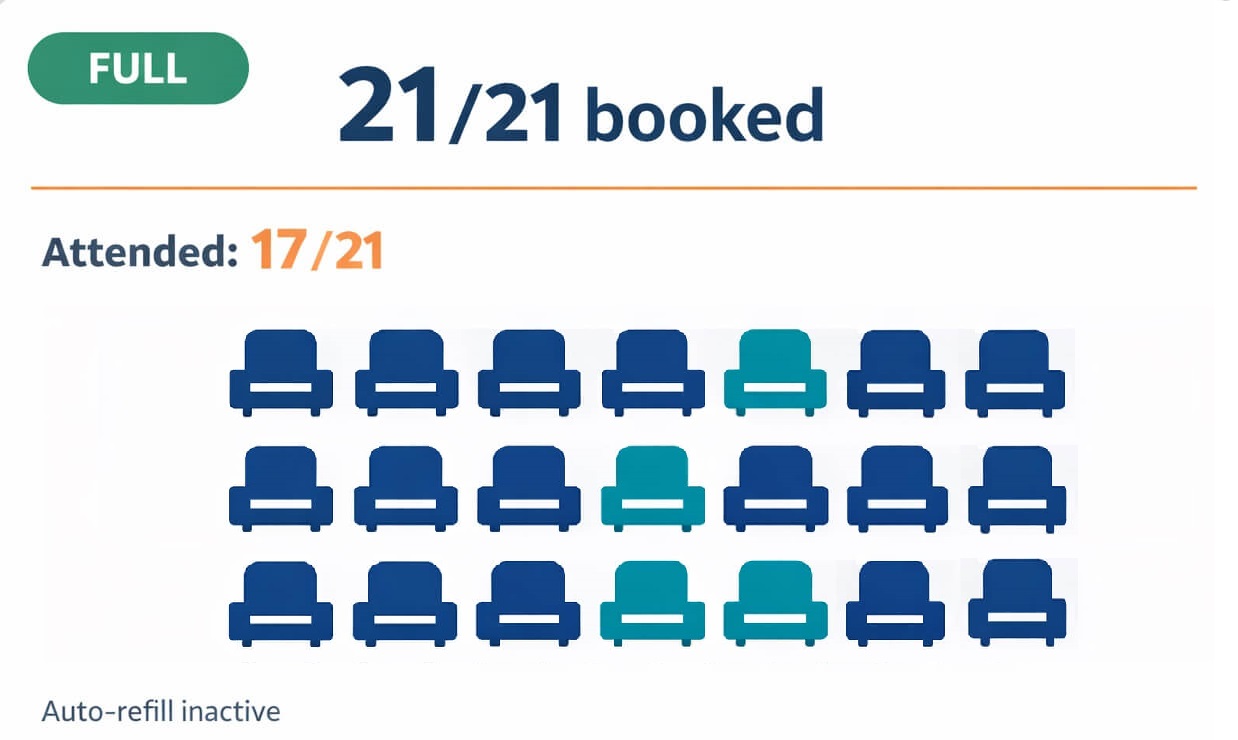
Your calendar says full. Your capacity isn’t.

Industry data shows that 10–25% of booked capacity is typically lost to no-shows and late cancellations.

Most booking systems stop when your calendar fills. Bookcessful is built for what happens next.

Waitlist support for full workshops — built on a smarter booking system.

Free, but a real account (not just a demo). No Credit card needed.

Bookcessful at a glance

Capacity management with waitlist handling (group events) Capacity management with waitlist handling (group events) Capacity management with waitlist handling (group events)

Capacity management with waitlist handling (group events)

For full workshops and classes, Bookcessful keeps demand in motion with automatic waitlists and spot re-offers when cancellations happen.

Even and fair distribution (monthly planner) Even and fair distribution (monthly planner) Even and fair distribution (monthly planner)

Even and fair distribution (monthly planner)

If you run recurring sessions, monthly planning helps distribute attendance and workload more evenly across dates and groups.

Simple consultant 1:1 booking (single events) Simple consultant 1:1 booking (single events) Simple consultant 1:1 booking (single events)

Simple consultant 1:1 booking (single events)

For one-to-one consulting scenarios, single-event booking provides a straightforward flow with clear slots and fast confirmations.

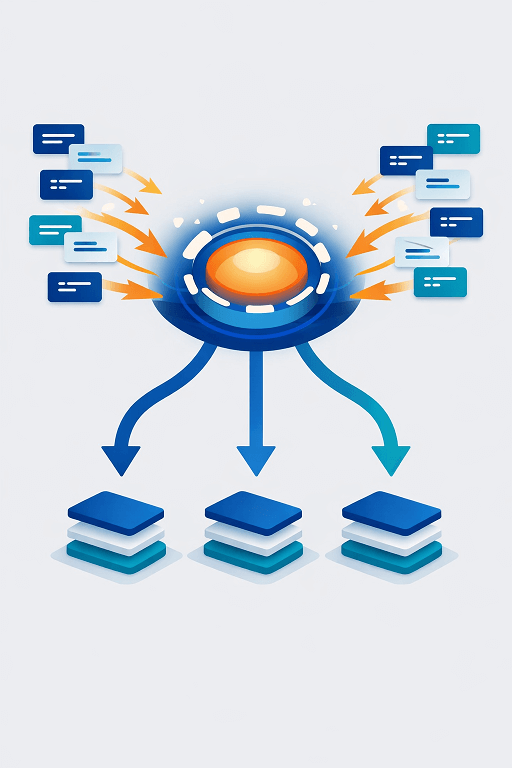
Illustration of capacity and waitlist management for group events

Bookcessful in detail

This system offers extensive capacity and waitlist management solutions designed to optimize event and appointment scheduling, particularly when demand exceeds available slots. Its main features include individual and group booking capabilities, automated waitlist handling, fairness algorithms for fair participant distribution, and flexibility for managing multiple sessions or time slots, all aimed at reducing no-shows, maximizing utilization, and streamlining manual follow-ups. It solves challenges related to overbooked calendars, underutilized capacity, last-minute cancellations, and resource allocation, making it ideal for event organizers, educational institutions, training providers, and service-based businesses seeking to maintain fairness, efficiency, and improved revenue through intelligent scheduling and waitlist automation.

After full capacity - the operational problems most booking systems ignore

These are the failures organizers face after sessions are already full.

Because they stop at the booking moment. The real workload starts after full capacity: cancellations, replacements, fairness decisions, and constant reprioritization.

Most waitlists are passive name lists without decision logic. Under pressure, every slot becomes a manual negotiation, so speed and fairness collapse together.

Because cancellations happen late and recovery is slow. Without active backfill rules, freed capacity expires before the right participant confirms.

The same people apply repeatedly while capacity stays fixed. Without recurring balancing, access drifts toward whoever reacts fastest, not toward fair rotation.

When allocation is manual, decisions look personal even when they are not. Missing transparent rules turns every denied seat into a trust problem.

A cancelled seat is not neutral. If it is not recovered in time, you lose both utilization and income while still carrying fixed operational cost.

Because each change triggers multiple messages, exceptions, and follow-ups. With recurring demand, admin effort grows faster than participant count.

They are managing live demand with static tools. Every day starts with backlog: unanswered messages, unresolved swaps, and fairness decisions deferred to the evening.

Fairness is load-bearing infrastructure. Predictable rules reduce conflict, protect staff energy, and keep recurring groups psychologically stable over time.

It means treating full capacity as the start of control work: waitlist activation, cancellation recovery, recurring balancing, and transparent allocation governance.

When your event is full, the real operational game begins

When full capacity starts to hurt

  • Last-minute cancellations and reopened spots
  • Manual follow-ups that slow your team down
  • Fairness questions about who gets the next place
  • Lost participants and lost revenue

(Three people are still emailing you. Two are waiting. One already dropped out.)

This is not a scheduling problem. This is a capacity problem.

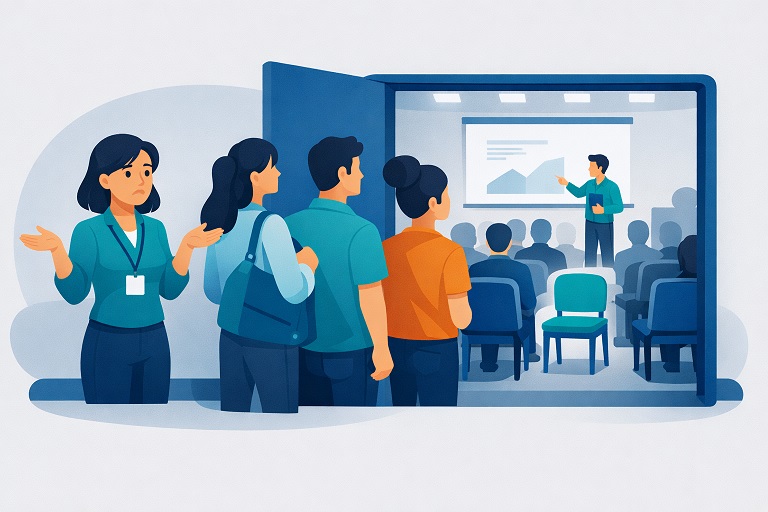
Organizer in a half-empty workshop room after participant cancellations
The most common situations where Bookcessful delivers a real edge:

The most common situations where Bookcessful delivers a real edge:

Balanced load and fair distribution

If you run parallel groups or multiple time slots, Education lead, Large event organizer, and Even monthly load show how to keep the workload even.

Curated decisions with smart automation

When participant quality matters, Workshop host, Premium training, and Guardrails for goodwill show how to keep control without chaos.

Tight capacity, long waitlists

If demand is high, Long waitlist, Scarce capacity, and Family signups keep the queue clear and fair.

Rhythm and consistency

When predictable attendance matters most, Monthly course, Preparatory- / therapy / development group, and Shift scheduling show how to distribute slots evenly.

If you use Bookcessful: What happens when the event is full?

From that point on, Bookcessful responds automatically.

New interested people line up instead of getting lost.

If someone cancels, Bookcessful fills the freed spot from the waitlist — based on your rules.

Bookcessful decides who to message first based on your rules. No explanations needed. You can step in manually if you want, or let Bookcessful handle the organizing.

Stays manageable even after it’s full.

If you use Bookcessful: What happens when the event is full?

Reviews

Real feedback from organizers like you

Experiences from teams that filled their sessions with Bookcessful.

Hannah
Hannah
Fiverr

The fact that there is no generic or sandbox demo is actually a major strength, especially for practicioning organizers. When users click "Start a real event" they're not watching a walkthrough, they're creating a real account, setting up real services, and collecting real bookings immediately via public booking links. That changes everything.

Nick
BacklinkLog

Congrats on launching Bookcessful! Capacity-aware booking is such a smart niche - most tools stop at "fully booked" and leave organizers scrambling. I liked how you framed it on your site: "This is not a scheduling problem. This is a capacity problem." That distinction is clear and compelling.

Your calendar says full. Your capacity says otherwise.

Your calendar says full. Your capacity says otherwise.

You launch the event booking. You share the link.

Sign-ups arrive.

While seats are available, the flow feels simple.

The real test starts when your calendar shows full.

Industry data shows that 10–25% of booked capacity is typically lost to no-shows and late cancellations.

That’s where most booking tools quietly stop working — and hidden capacity begins to leak.

Bookcessful keeps the process under control.

No more manual notes, circling and crossing things out.

No more last-minute emails or text messages trying to fill gaps.

Instead, you see your event stay structurally stable — even under pressure.

(We learned this the hard way too. The real bottleneck wasn’t getting bookings. It was what happened after the event filled.)

Bookcessful doesn’t just help you react to changes — it helps you stay ahead of them. By continuously monitoring booking patterns, cancellations, and attendance behavior, the system flags emerging risk early and supports smarter refill decisions. Combined with automated waitlist actions and precisely timed notifications, this means fewer empty seats and more reliable attendance — without adding manual workload. Because staying “full” in the calendar isn't the same as staying full in reality.

Stays manageable even after it’s full.

Works with your existing calendar

Your calendar stays the center.

It stays clear in Google Calendar and Outlook.

Bookcessful builds on the tools you already use — it complements and supports them.

Stays manageable even after it’s full.

Works with your existing calendar

Key insights for organizers

Start with these articles to see where capacity is lost after an event is full.

When demand is high, your system should be stronger.

First steps
When demand is high, your system should be stronger.